
Mock test
UK mock theory test
Last reviewed against gov.uk on

A mock theory test mirrors the real UK driving theory test so you can practise under exam-like conditions before the day. The real test is 50 multiple-choice questions in 57 minutes (pass mark 43 out of 50) followed by a 14-clip hazard perception test (pass mark 44 out of 75). A good mock covers the same syllabus, the same question style, and the same time pressure.
Those figures are the car and motorcycle test. The lorry and bus test and ADI Part 1 use a longer paper with their own pass marks, so mock yourself against the right format if you are sitting either.
You can practise both parts of the theory test online.
What a real DVSA mock test looks like
| Section 1 | 50 multiple-choice questions in 57 minutes |
|---|---|
| Section 1 pass mark | 43 out of 50 |
| Question style | Single-answer multiple choice, plus 3 questions about a short silent video clip |
| Optional break | Up to 3 minutes between the two sections |
| Section 2 | 14 hazard perception video clips (15 scored developing hazards) |
| Section 2 pass mark | 44 out of 75 |
| Result | Pass or fail shown on screen at the end |
Where to take a free mock theory test
- GOV.UK offers a free practice theory test and 3 free hazard perception clips. Useful for getting a feel for the format; not enough to revise the whole syllabus.
- Our Driving Theory Test Kit UK app has 750+ free DVSA revision questions, the hazard perception structure and the latest Highway Code — no account, no paywall on the question bank. Available on iOS and Android.
How to use mock tests effectively
- Start with topic practice, not full mocks. Work through the 14 DVSA syllabus topics one at a time so you know what’s tested where.
- Take a full mock after each two or three topics. Time yourself — 57 minutes for the multiple-choice section.
- Track which topics you fail. The real-test result letter tells you which parts you did not score enough points on — practising by topic makes that breakdown actionable.
- Practise hazard perception separately. The click-timing skill is different from multiple-choice recall — see our hazard perception explainer.
- Aim for 48/50 or higher in practice. Real-exam nerves cost a few marks; 43/50 in practice is too close to the threshold.
Try a sample question
Here’s one real DVSA revision question from the hazard awareness topic, formatted as you’ll see it in the app.
Practice question
From the DVSA revision question bank
What's the main hazard shown in this picture?
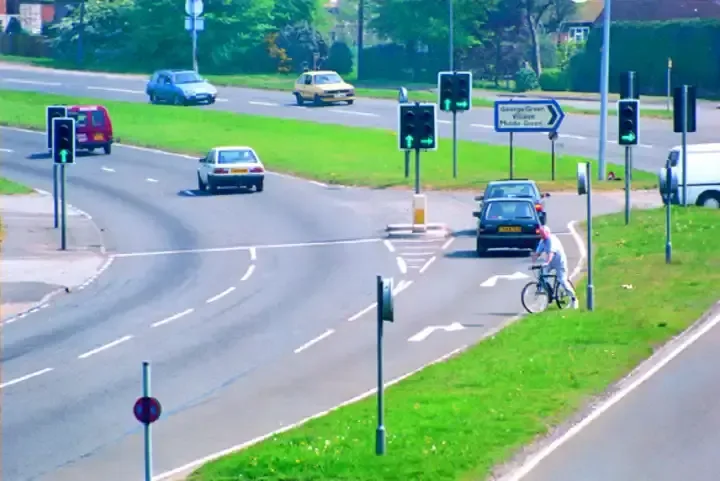
Show explanation
The correct answer is C.
Look at the picture carefully and try to imagine you're there. The cyclist in this picture appears to be trying to cross the road. You must be able to deal with the unexpected, especially when you're approaching a hazardous junction. Look well ahead to give yourself time to deal with any hazards.
Want more practice? Get free DVSA revision questions, hazard perception clips and the latest Highway Code in our app.


The whole set — road signs and hazard awareness, each with the correct answer and a full explanation.
Practice by syllabus topic
The DVSA car theory test syllabus has 14 topics. Each topic page below summarises what’s tested, links the key Highway Code rules and runs through common mistakes.
- Alertness
- Attitude
- Safety and your vehicle
- Safety margins
- Hazard awareness
- Vulnerable road users
- Other types of vehicle
- Vehicle handling
- Motorway rules
- Rules of the road
- Road and traffic signs
- Documents
- Incidents, accidents and emergencies
- Vehicle loading
Mock test vs the real exam: what’s the same and what’s different
The same: question format, syllabus, pass marks, and time limits. Reputable practice apps (including ours) draw from the same DVSA revision question bank — 750+ questions in active rotation for the car test — so the topics, difficulty and answer patterns match.
The differences are practical, not content-based. The real test is taken at a DVSA-contracted test centre — operated by Pearson (formerly Pearson VUE) or Reed in Partnership — on a DVSA computer; phones and watches go in a locker; results print on the day. Wording may differ slightly between a practice app and the live exam, and the live test draws 50 questions at random — you will not see an identical paper.
Why mocks often feel harder than the real test
A recurring sentiment among UK learners is that practice apps feel harder than the live DVSA exam, then panic that the gap is a sign the live test will sandbag them. The gap is almost always a side effect of how mocks are built, not a sign that the real test is easier on you.
- Mocks sample the whole bank; the real test samples a curated subset. The DVSA car revision bank runs to 750+ questions; a mock test pulls 50 from any of them, weighted uniformly. The live exam pulls from the same pool but the per-sitting selection skews to the syllabus areas DVSA wants every driver to be confident on. Over many mocks you encounter the obscure questions; over one real sitting you usually don't.
- Mock difficulty is uniform; the real test has an easy-to-hard mix. Real exam papers blend a few straightforward questions with the trickier ones to give every candidate reachable wins. Mocks tend not to curate the mix, so the perceived difficulty per question can be flatter and higher.
- You score yourself harder in practice. In a mock you see every wrong answer immediately; in the real test you see only a topic breakdown. The mock's running tally feels brutal even if your end score is identical.
- Some apps reuse retired or motorbike-bank questions. Older or off-category questions can make a mock feel like a different exam entirely. Stick to apps that source from the current car-only DVSA bank.
- The real test has momentum the mock doesn't. 57 minutes in a quiet test centre with a printed result at the end is a different psychology to a 3-minute mock between bus stops. Most candidates report the live test felt easier than mocks because of this — not because the questions were easier.
Practical takeaway: stop benchmarking against 43/50 (the pass mark) on mocks. Benchmark against 48/50 consistently across the last 10 attempts. That cushion eats the test-day nerves and the few questions whose wording reads slightly differently.
Before you book the real test
When you’re consistently scoring above the pass mark on full mock tests, book the real exam through the official service at gov.uk/book-theory-test — see our booking step-by-step for the full flow. The fee is £23 for the car or motorcycle test.
Sources
- GOV.UK — Take a practice theory test
- GOV.UK — Theory test: multiple-choice questions
- GOV.UK — Theory test: hazard perception test
- GOV.UK — Theory test: pass mark and result
- GOV.UK — Book your theory test
- Find a Tender — Future Theory Test Service (FTTS) contract notice
- Safe Driving for Life — The Official DVSA Theory Test for Car Drivers (revision question bank)